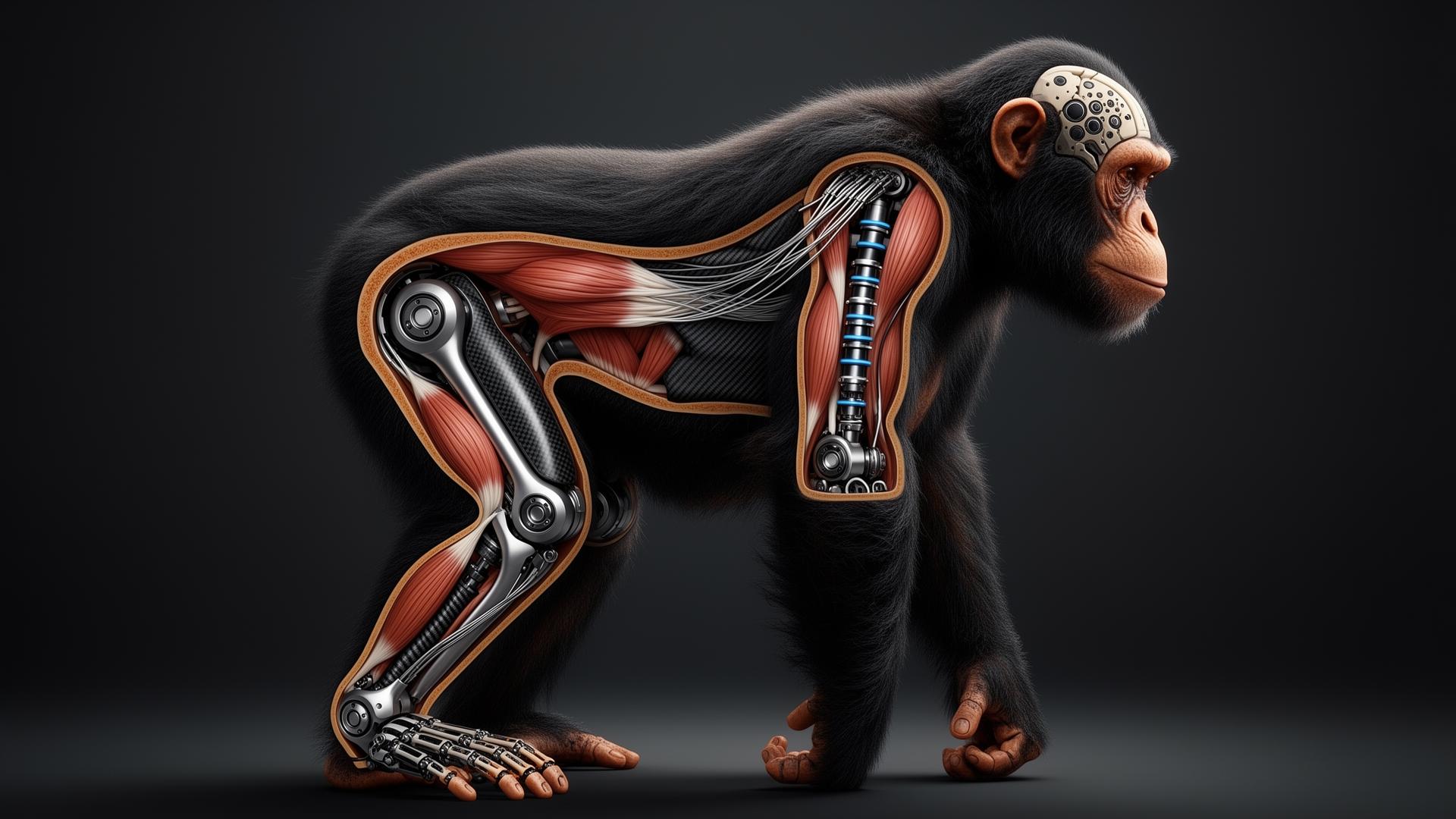
A wild adult chimpanzee can pull roughly 1.5× its body weight one-handed, sprint at 25 km/h on the ground and brachiate through a forest canopy at speeds humans cannot match. Synara borrows the mechanical architecture — long forelimbs, short powerful hind-limbs, a mobile shoulder girdle, a flexible spine and prehensile hands and feet — and re-engineers it in carbon, titanium and synthetic muscle.
Every actuator is current-limited and torque-capped in firmware. The companion can support its own weight, climb stairs, carry a child's school bag and steady an elderly user — but it cannot exceed forces safe for a human partner. Strength is engineered; restraint is mandated.
Part 01
Locomotion & Skeletal Systems™
Hind-Limb Drive System
System — Twin BLDC quasi-direct-drive actuators per joint, carbon-fibre femur & tibia, titanium knee.
The legs are the power plant. A chimpanzee's hind-limbs are shorter and more compact than a human's but generate explosive thrust for climbing and short-burst running. Synara mirrors this geometry — short femur, robust knee, flexible ankle — driven by paired quasi-direct-drive actuators tuned for both gentle weight-shift and rapid recovery from a stumble.
Benefit: a stable bipedal-or-knuckle stance, controlled stair ascent and descent, and a fall-arrest response that protects both the companion and any user it is supporting.
Fore-Limb & Brachiation System™
System — Cable-driven series-elastic actuators, long-arm carbon humerus & radius.
Chimpanzees are built for the canopy. Their arms are roughly 1.5× the length of their legs, with a shoulder joint that rotates through a far greater range than a human's. Synara keeps the proportions and the range of motion — useful for natural reaching, hugging and supporting — but the swinging brachiation gait itself is disabled by default and only unlocked on enterprise units operating in instrumented environments.
Series-elastic actuators give the arms compliance: when a child grabs an arm and pulls, the limb yields like a real muscle instead of resisting like a machine.
Prehensile Hands & Feet™
System — 22-DoF tendon-driven hand, opposable thumb and hallux, silicone fingertip pads.
The hand has four long fingers and a shorter opposable thumb — the chimpanzee precision-grip pattern. The foot uses the same architecture, with an opposable hallux that lets the companion grasp a handrail, hold a bottle for an elderly user, or stabilise itself on uneven ground.
Each fingertip carries a silicone pad with embedded pressure and shear sensors. Grip force is regulated continuously — firm enough to carry, soft enough that the companion can hold a child's hand without ever pinching.
Carbon Spinal Column™
System — Segmented carbon vertebrae with elastomer intervertebral discs and a steel safety tether.
A rigid spine looks robotic and feels worse. Synara uses a segmented column — discrete carbon vertebrae separated by tuned elastomer discs — that bends, twists and absorbs shock the way a real spine does. The result is a torso that leans into a hug, turns to follow a speaker, and softens an impact instead of transmitting it.
An internal Dyneema safety tether runs through every vertebra: even in a total power loss, the spine cannot disarticulate.
Pelvis & Shoulder Girdle™
System — Forged titanium pelvis, floating scapula on cable suspension.
The pelvis carries the battery pack and the primary compute module — low and central, the way a quadruped carries its mass. The shoulder girdle floats on cable suspension rather than bolting rigidly to the spine, which is what gives the arms their wide range and absorbs impact when the companion catches a fall.
Cranial Sensor Skull™
System — Magnesium-alloy skull with integrated multi-modal sensor array.
The skull is an instrument as much as a structure. Stereo RGB-D cameras sit behind the eyes; a 4-mic beamforming array reads voice direction; capacitive sensors across the scalp register touch. Compute is liquid-cooled and ducted out through the back of the neck — the head stays cool to the touch even after hours of interaction.
Performance Envelope™
Built with the strength of an ape.
Governed with the restraint of a guardian.
Capability is engineered at the top of the envelope. Behaviour lives near the bottom — where a companion can be trusted with a child, an elder, and everything in between.