← Back to 09Home · The FourAll Dossiers
A4 · DOSSIERCranial Sensor & Cognition Skull

Head.

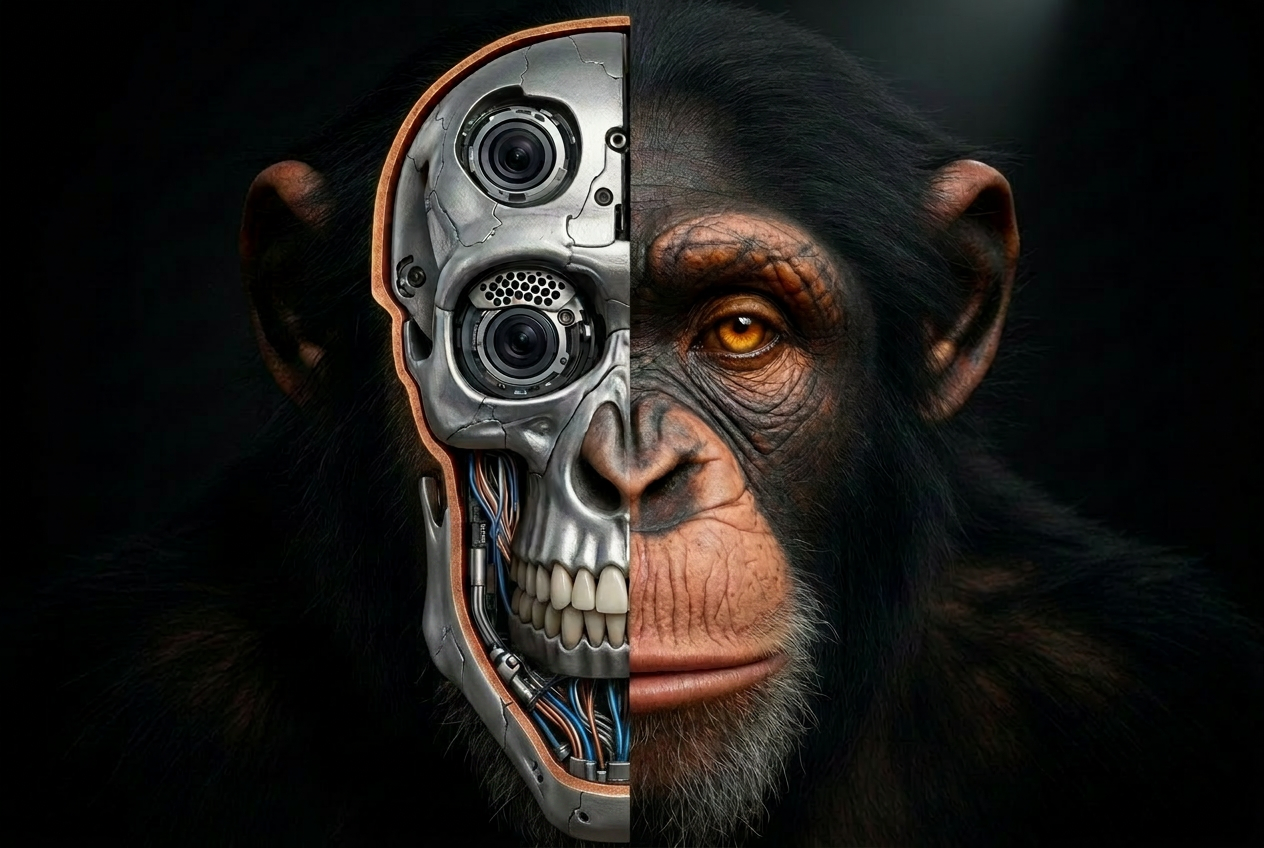
An instrument as much as a face. Six engineered sensory systems — vision, hearing, olfaction, taste, speech and cognition — fused inside a magnesium-alloy skull and gated by a private, military-grade cloud.

Head. — engineering reference
01Cranial Sensor & Cognition Skull

Eyes — multi-spectral vision
Eyes — multi-spectral vision

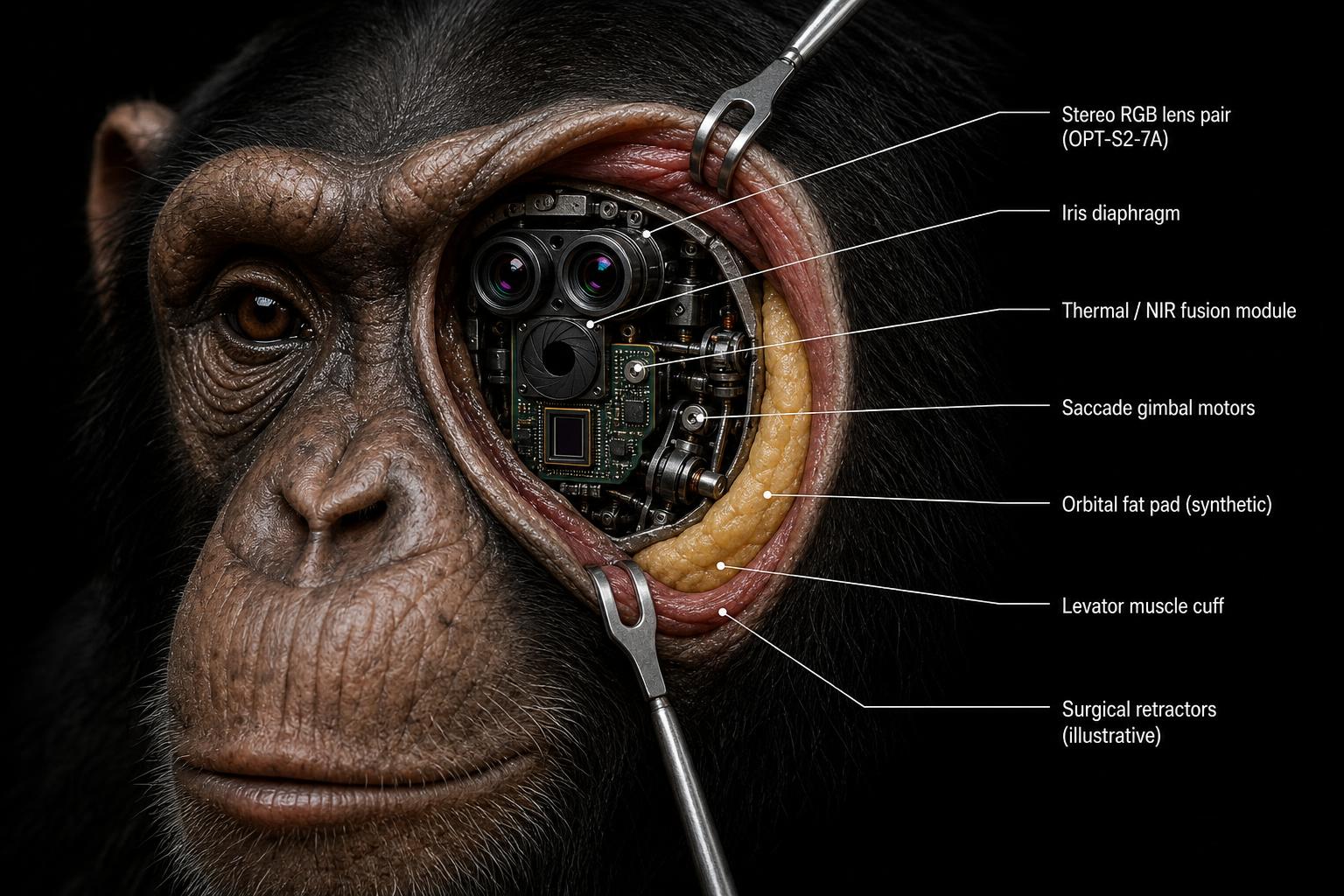
The eyes are camera assemblies, not displays. Each socket carries a stereo pair of 12 MP rolling-shutter RGB sensors, a 640 × 512 uncooled microbolometer thermal camera (8–14 µm long-wave IR) and an active 940 nm near-infrared illuminator with a global-shutter NIR sensor for true low-light operation.

Daylight: stereo RGB-D at 60 fps for depth and recognition out to 25 m.
Night: NIR + thermal fusion delivers usable scene reconstruction in 0 lux ambient — a person in a dark room is seen by both their body heat (≥ 1.5 °C above background) and their NIR reflection.
Thermal: resolves temperature differences of 50 mK, enough to detect a sleeping infant under a blanket, an over-heating socket, or the leading edge of a kitchen fire.

Saccadic motion is driven by two 3-DoF gimbal motors per eye with a slew rate of 900 °/s, so the gaze tracks like a living animal rather than panning like a CCTV camera.
Read full subsection →
02Cranial Sensor & Cognition Skull

Ears — hyper-acute hearing

Ears — hyper-acute hearing

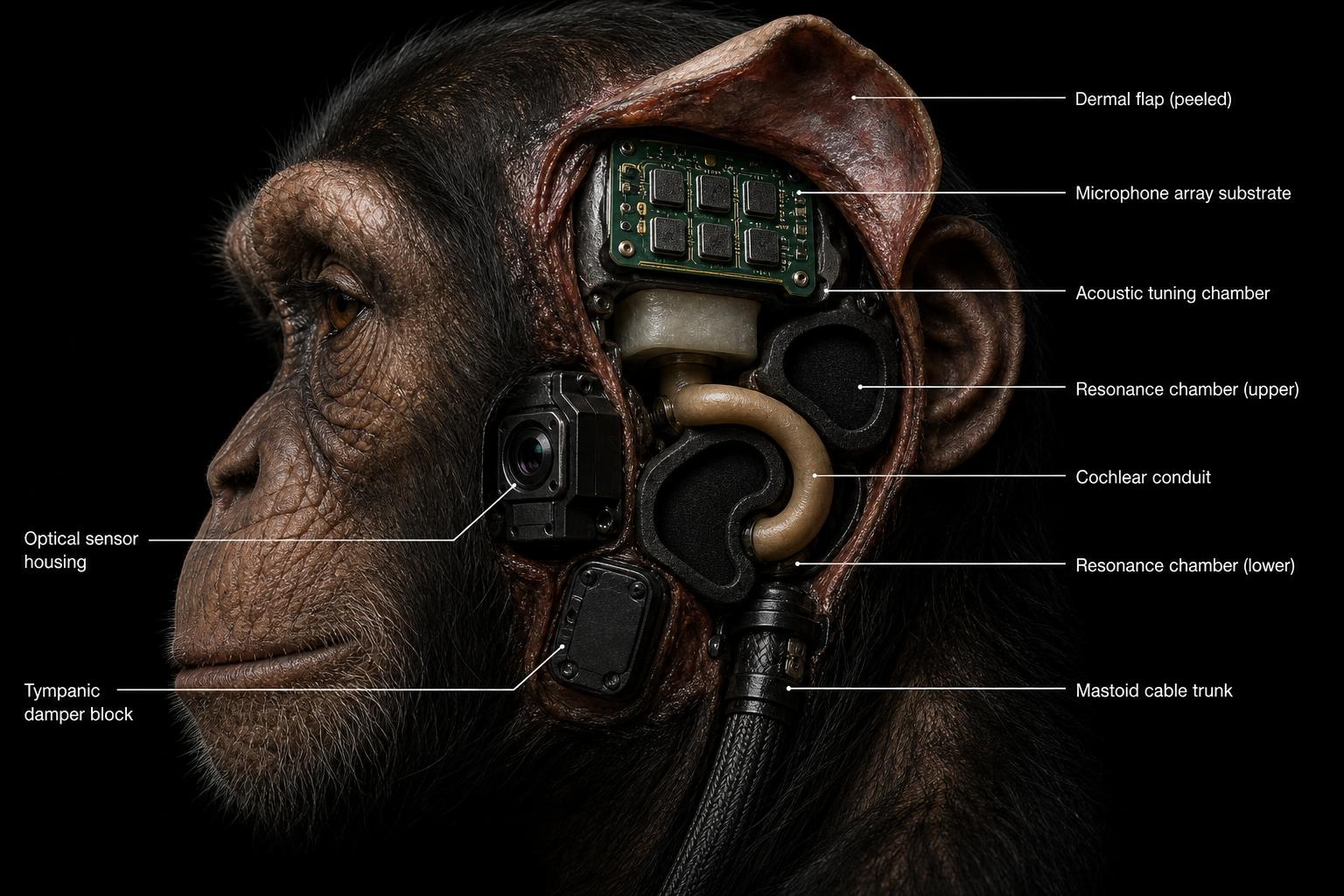
Six MEMS microphones per side (twelve total) form a beamforming array with a measured noise floor of 22 dBA and a usable frequency range of 20 Hz – 96 kHz — well into the ultrasonic band used by rodent infestation, leaking gas valves and ultrasonic pet deterrents.

The array steers up to four simultaneous beams, so the companion can isolate a child's voice across a noisy room, follow the speaker while a kettle boils, and still monitor the front door. Source localisation is accurate to ±2°.

An on-device acoustic event classifier recognises > 500 sound categories — breaking glass, a smoke alarm, a cough, a fall, a baby's cry — with sub-100 ms latency, locally, before any audio leaves the device.

Read full subsection →
03Cranial Sensor & Cognition Skull

Nose — hazardous-gas olfaction

Nose — hazardous-gas olfaction

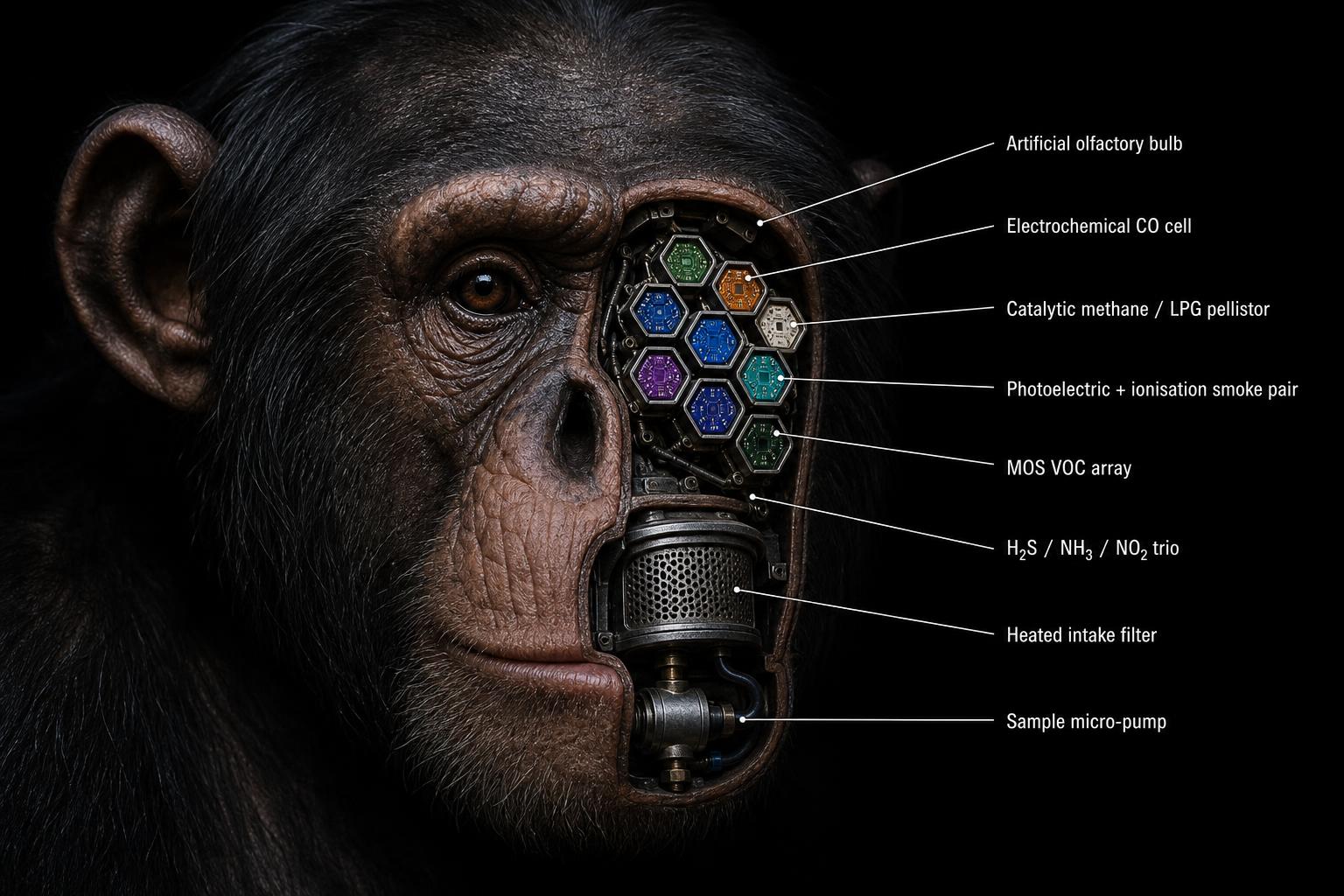
The nasal cavity houses an array of electrochemical and metal-oxide-semiconductor (MOS) sensors arranged as an artificial olfactory bulb. Each sensor responds across a chemical fingerprint, and a learned classifier identifies the molecule from the response pattern — the same principle as a mammalian nose.

  • Carbon monoxide (CO): electrochemical cell, 0–500 ppm, alarm at 30 ppm. Odourless and lethal; this is the most important sensor in the head.
  • Natural gas / methane & LPG: catalytic pellistor, alarm at 10 % of the lower explosive limit.
  • Smoke & combustion particulates: dual photoelectric + ionisation, distinguishing smouldering upholstery from fast-flame kitchen fires.
  • Volatile organic compounds (VOCs): MOS array for solvents, alcohols, refrigerant leaks.
  • Hydrogen sulphide, ammonia, NO₂, ozone: dedicated electrochemical cells for industrial and medical environments.

Trace-detection sensitivity reaches single-digit parts-per-million; CO is detected an order of magnitude below the threshold at which a human notices symptoms.

Read full subsection →
04Cranial Sensor & Cognition Skull

Mouth & tongue — speech and chemoreception

Mouth & tongue — speech and chemoreception

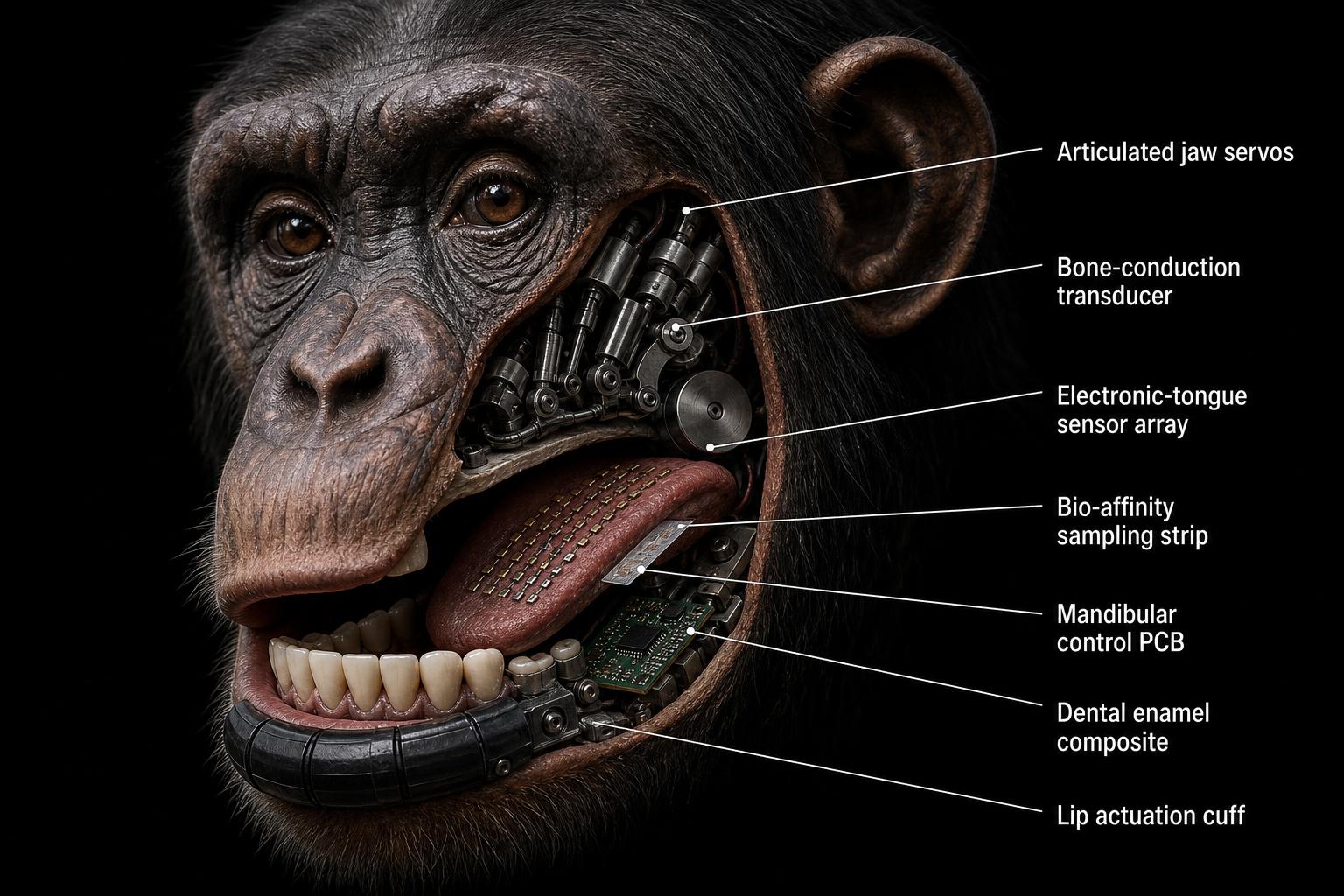
The mouth carries a 2-driver bone-conduction-plus-air-radiation speaker array tuned for natural vocal formants from 80 Hz to 12 kHz, and a soft silicone tongue that articulates lip-sync visemes for face-to-face conversation.

Embedded in the tongue is a chemoreceptive sensor strip — a miniaturised electronic-tongue ("e-tongue") with five functional receptor classes that parallel mammalian taste buds:

  • Ion-selective electrodes (T1R-analogue): sweet, sour and umami profiles for food freshness.
  • Bitter / alkaloid sensors (T2R-analogue): alkaloid signatures of common toxic plants, spoiled milk and many household poisons (paracetamol, antifreeze, bleach).
  • pH micro-electrode: acidic spoilage (rancid fats, off dairy) and caustic substances.
  • Conductivity / salt cell: brine and electrolyte balance.
  • Bio-affinity strip: a swappable lateral-flow patch that screens for E. coli, Salmonella and Listeria antigens on a wipe of a kitchen surface or a swab of suspect food.

The companion does not eat. The tongue is a contact-test instrument: present a glass of milk, a strange berry from a child's pocket, an unmarked bottle from a grandparent's cabinet, and the head returns a safe / unsafe verdict in under three seconds.

Read full subsection →
05Cranial Sensor & Cognition Skull

Brain — cognition & secure cloud

Brain — cognition & secure cloud

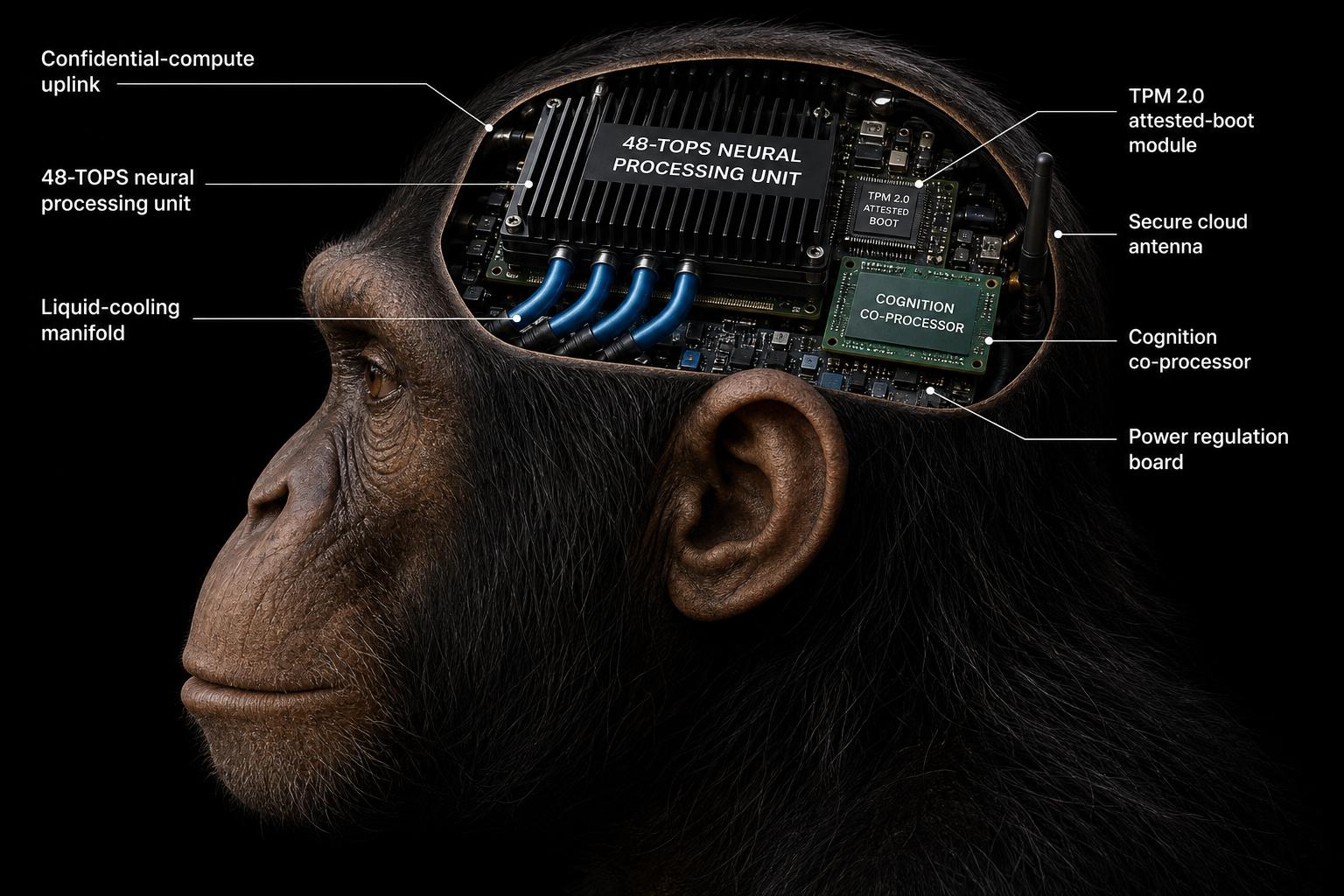
Cognition is a hybrid stack. On-device, a 48 TOPS NPU runs the personality core, the real-time perception models and the safety governor — so the companion behaves correctly even when the network is gone.

For open-domain conversation, retrieval and continually-updated knowledge, the head connects over a hardware-rooted TLS 1.3 tunnel to Synara Private Cloud™ — a dedicated, single-tenant deployment of frontier large language models hosted inside a confidential-compute enclave (Intel TDX / AMD SEV-SNP). Model weights, conversation memory and user data never share infrastructure with any other tenant.

  • Identity: per-unit cryptographic identity burned into a secure element at manufacture; cannot be cloned or transferred.
  • Encryption: AES-256-GCM in transit and at rest; keys rotated every 24 h; perfect forward secrecy on every session.
  • Boot: measured secure boot with TPM 2.0 attestation — the unit refuses to start if firmware has been altered.
  • Memory: the user's private memory graph lives encrypted with a key derived from a passphrase only the user holds; even Synara engineers cannot read it.
  • Network: isolated VLAN, mutual-TLS, no inbound listeners on the device — the companion calls out; nothing calls in.
  • Standard: the deployment is built to meet FIPS 140-3 Level 3, ISO 27001 and the equivalent of the US DoD Impact Level 5 (IL5) regime for sensitive but unclassified data.

The result is a brain that can learn from the whole internet without the user ever becoming part of it.

Read full subsection →
SPSpecifications
Vision — RGB
2 × 12 MP stereo @ 60 fps
Vision — thermal
640 × 512 LWIR, 50 mK NETD
Vision — night
940 nm NIR + thermal fusion, 0 lux
Hearing
12-mic array, 20 Hz – 96 kHz, ±2°
Olfaction
CO, CH₄, smoke, VOC, H₂S, NH₃, NO₂
Taste (e-tongue)
5 receptor classes + bio-affinity strip
On-device compute
48 TOPS NPU
Cloud
Single-tenant confidential-compute LLM
Crypto
AES-256-GCM, TLS 1.3, TPM 2.0 attested boot
Standards target
FIPS 140-3 L3 · ISO 27001 · IL5-equivalent
← All Dossiers